
The defining laptop trend of 2026 isn’t just AI but it’s repairability. Frustrated by glued-shut hardware, consumers and regulators are forcing a massive shift in design. At CES 2026, Lenovo shocked the industry by unveiling the highly modular ThinkPad X1 Carbon Gen 14 with a new “Space Frame” chassis. But how does this new wave of modularity compare to the “normal” premium laptops from Apple and HP that dominate the market?
Are modern premium laptops becoming easier to repair in 2026?
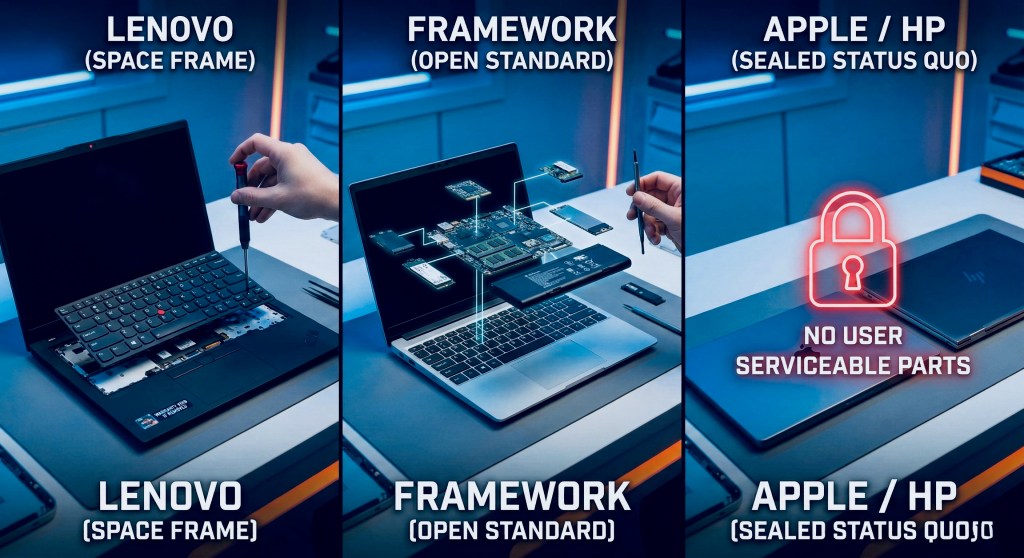
Yes and no. While brands like Framework offer fully modular designs and Lenovo is introducing repairable “Space Frame” chassis, the traditional market leaders are lagging. Apple’s newest M4 MacBooks still feature soldered RAM and storage, heavily relying on software locks that hinder third-party repairs. Meanwhile, premium Windows devices like the HP Spectre series allow SSD upgrades but continue to solder RAM directly to the motherboard.
For the last decade, the formula for a premium laptop was simple: make it as thin as a smartphone, glue the battery down, solder the RAM to the motherboard, and use proprietary screws to keep the owner out.
But in early 2026, a massive hardware rebellion is officially going mainstream. The “Right to Repair” movement has evolved from a niche rallying cry on Linux forums into a core product strategy for enterprise giants. Let’s look at the real-life hardware proving that the era of disposable laptops is ending, and see how it contrasts with the stubbornly locked-down machines sitting on store shelves today.
1. The CES 2026 Bombshell: Lenovo’s “Space Frame” 🛠️
Lenovo’s ThinkPad lineup has always been the gold standard for IT professionals, but recent ultra-thin models sacrificed upgradeability. At CES 2026 in January, Lenovo reversed course with the ThinkPad X1 Carbon Gen 14 Aura Edition.
Lenovo’s engineers restructured the internals entirely around a new concept called the “Space Frame”.
- Two-Sided Motherboard: By making the motherboard two-sided and about two-thirds of its previous size, Lenovo freed up massive thermal space.
- Modular Components: The battery, keyboard, speakers, fans, and even the USB-C ports can now be easily removed and replaced.
- The Result: This radical redesign earned the new ThinkPad X1 a staggering 9 out of 10 repairability score from iFixit.
Do you want to know Why Many Linux Users Prefer Lenovo ThinkPad Laptops Even in 2025? Have a read!
2. The Poster Child: The Framework Standard ⚙️
Lenovo didn’t innovate in a vacuum; they are responding to Framework, the undisputed darling of the right-to-repair movement.
Framework proved that a laptop doesn’t have to be a sealed black box. Their design philosophy is radical transparency:
- Every single component can be replaced by the end-user using a single included screwdriver.
- Framework provides a dedicated Marketplace where anyone can buy first-party replacement parts, right down to the mainboard.
- You can even hot-swap your side ports (USB-C, HDMI, MicroSD) on the fly using their Expansion Card system.
3. The “Normal” Standard: Why Apple and HP Are Falling Behind 🛑
To truly appreciate Framework and Lenovo’s new designs, we have to look at the “status quo” of premium consumer laptops in 2026.
The Apple Approach: The “Software Lock”
Even with the latest M4 MacBook Air, Apple is actively fighting independent repair. While iFixit noted that Apple thankfully made the USB-C ports modular, the rest of the machine is a repair nightmare:
- Soldered Everything: The storage and memory are fully integrated into the M4 chipset, meaning upgrades are impossible.
- Parts Pairing: Apple uses software locks to bind components to the logic board. If you swap a perfectly working screen from one M4 MacBook to another, Apple’s System Configuration software will disable True Tone and throw calibration errors. This earned the M4 MacBook Air a mediocre 5/10 repairability score.+1
The HP Approach: The “Half-Measure”
Look at a premium Windows machine like the HP Spectre x360. It sits awkwardly in the middle ground.
- The Good: Unlike MacBooks, you can actually open an HP Spectre with standard tools and physically swap out the M.2 NVMe SSD for more storage.
- The Bad: The memory is an integral part of the motherboard and cannot be upgraded. If your workflow suddenly requires 32GB of RAM instead of 16GB, you have to throw the entire laptop away and buy a new one.
Why People Still Use Windows OS in 2025 Even as MacOS and Linux Improve? Have a read!
4. The Catch: Why Lenovo Isn’t Framework (Yet) ⚠️
While Lenovo’s Space Frame is a massive leap over Apple and HP, there is a major caveat.
If you buy the $1,999 ThinkPad X1 Gen 14 in March and try to fix a broken USB port yourself, you will void your warranty. According to Lenovo, the only component end-users are officially authorized to replace themselves is the battery. The Space Frame was built to make life easier for corporate IT fleets and authorized technicians—not for the everyday consumer.
Table: The 2026 Repairability Showdown
How the top premium laptops of 2026 compare when it is time to open them up.
| Feature | Framework 13 | Lenovo ThinkPad X1 (Gen 14) | Apple MacBook Air (M4) | HP Spectre x360 |
| iFixit Score | 10 / 10 | 9 / 10 | 5 / 10 | N/A (Usually 4-6 / 10) |
| RAM Upgradeable? | Yes | Yes (Modular Boards) | No (Soldered) | No (Soldered) |
| SSD Upgradeable? | Yes | Yes | No (Soldered) | Yes |
| Parts Pairing (Software Locks) | None | None | High (Displays, Touch ID) | Low |
| DIY Warranty Voided? | No | Yes (Except Battery) | Yes | Yes |
Real Question: Which Approach Wins Your Wallet?
Not sure which philosophy suits your workflow? Here is the breakdown.
- IF you are a developer or Linux enthusiast who demands total ownership of your hardware…
- 👉 BUY A FRAMEWORK. You can upgrade the CPU mainboard three years from now. You own the hardware, and you own the right to fix it.
- IF you work in enterprise IT or need top-tier business reliability…
- 👉 BUY THE LENOVO X1. The Space Frame ensures your company’s IT guy can fix a broken fan in five minutes. Just don’t play mechanic yourself while it is under warranty.
- IF you treat your laptop like a sealed appliance and don’t care about e-waste…
- 👉 BUY THE MACBOOK OR HP. They are beautifully crafted machines, but you must buy maximum RAM on day one, and you will be completely at the mercy of the Genius Bar when things break.
Know more about MacBook vs Linux vs Windows: Which Laptop Should You Choose?
The Bottom Line
The era of treating a $2,000 computer like a disposable razor is ending. Lenovo’s ThinkPad X1 Gen 14 proves that ultra-thin premium laptops can be modular, putting traditional designs from Apple and HP to shame. Now, the industry just needs to take the final step and actually let the consumers hold the screwdriver.
 safa.tech.blog
Leave a comment