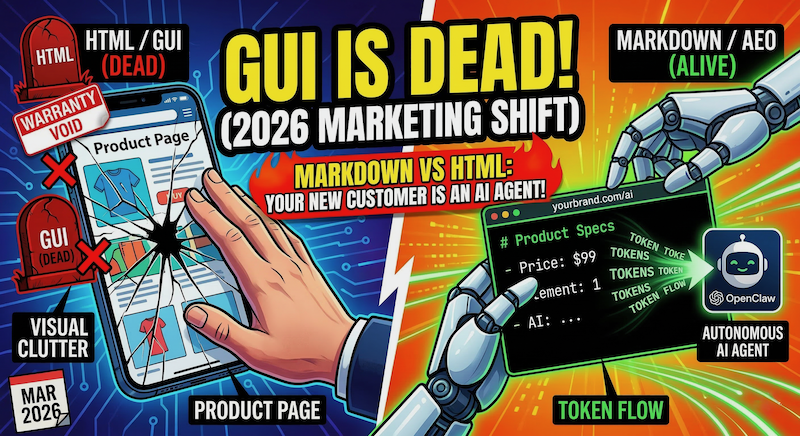
The target audience for your next B2B marketing campaign might not have a heartbeat. With the rapid rise of autonomous AI agents (powered by frameworks like OpenClaw), enterprise software purchasing is being automated. Gartner predicts traditional search volume will drop 25% this year, while the Agentic AI market explodes to $45 billion. To survive, marketers must pivot from traditional SEO to Answer Engine Optimization (AEO), trading heavy, visual HTML websites for clean, machine-readable Markdown.
What is Answer Engine Optimization (AEO)?
AEO is the practice of structuring website content so that autonomous AI agents and answer engines (like ChatGPT, Perplexity, and Google AI Overviews) can easily ingest, trust, and cite it. Unlike traditional SEO—which optimizes for human clicks via blue links AEO optimizes for machine legibility, prioritizing dense data tables, Markdown formatting, and direct, zero-click citations.
Bridging the gap between raw computer science architecture and high-level brand strategy is the core focus here at safa.tech.blog. Right now, there is a massive disconnect between how developers are building the web and how marketers are trying to sell on it.
If you spent the last five years perfecting your website’s visual user interface (GUI), obsessing over button colors and emotional copywriting, you are optimizing for a shrinking demographic. Read more about how the Agentic Web is unpacking Meta’s Moltbook and OpenAI’s Promptfoo Acquisitions.
Following Meta’s acquisition of the AI-only social network Moltbook, the reality of the 2026 internet is clear: we are entering the era of “Agentic AI.” When a CEO wants to research new payroll software, they no longer click through your carefully designed landing pages. They deploy an autonomous agent to scrape the web, compare pricing, and deliver a localized summary.
If your brand cannot be easily read by a machine, you simply do not exist in the agentic web. Here is the technical and strategic playbook for surviving the shift from SEO to AEO.
1. The Token Economy: Why AI Hates Your HTML
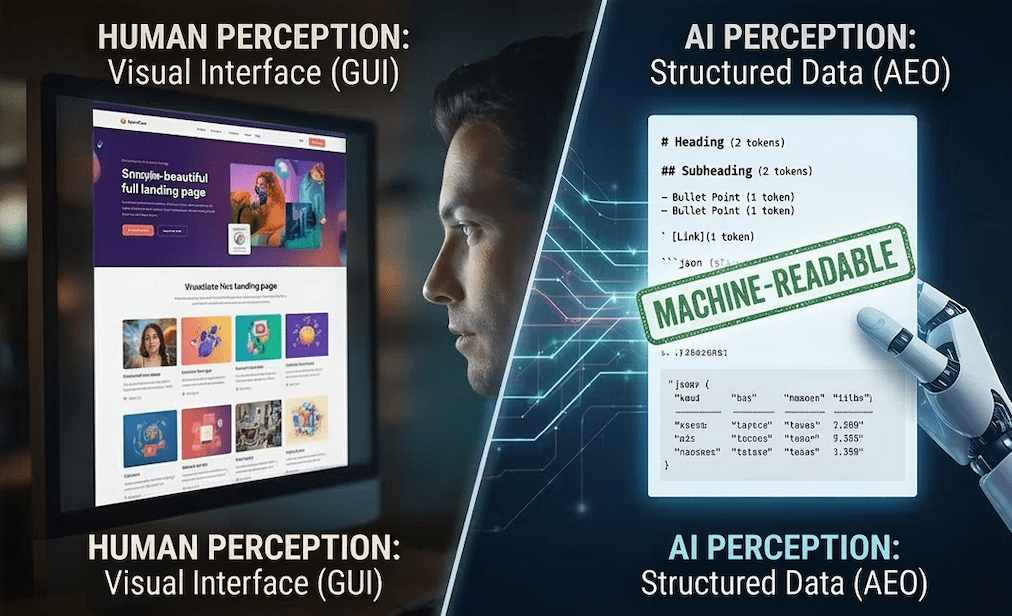
To market to an AI agent, you have to understand how it consumes data. AI models do not “read” websites; they process tokens.
Every single HTML wrapper, <div> tag, visual slider, and CSS class on your website consumes precious processing tokens without adding any semantic value. As Digiday recently highlighted in their technical breakdown, feeding an LLM raw HTML is like giving a chef your entire kitchen when all they asked for was the recipe. A simple “About Us” heading in HTML burns roughly 15 tokens. In Markdown (## About Us), it burns three.
This inefficiency is exactly why Cloudflare just launched “Markdown for Agents” in February 2026. This massive infrastructure shift automatically converts a website’s HTML into streamlined Markdown whenever an AI crawler requests it, resulting in an 80% reduction in token usage.
The Marketing Takeaway: Agents operate on strict token limits and compute budgets. If your pricing page requires an agent to parse 10,000 tokens of JavaScript just to find a single subscription tier, the agent will abandon your site and recommend your competitor whose data is cleanly structured.
2. The Rise of the llms.txt File 📄
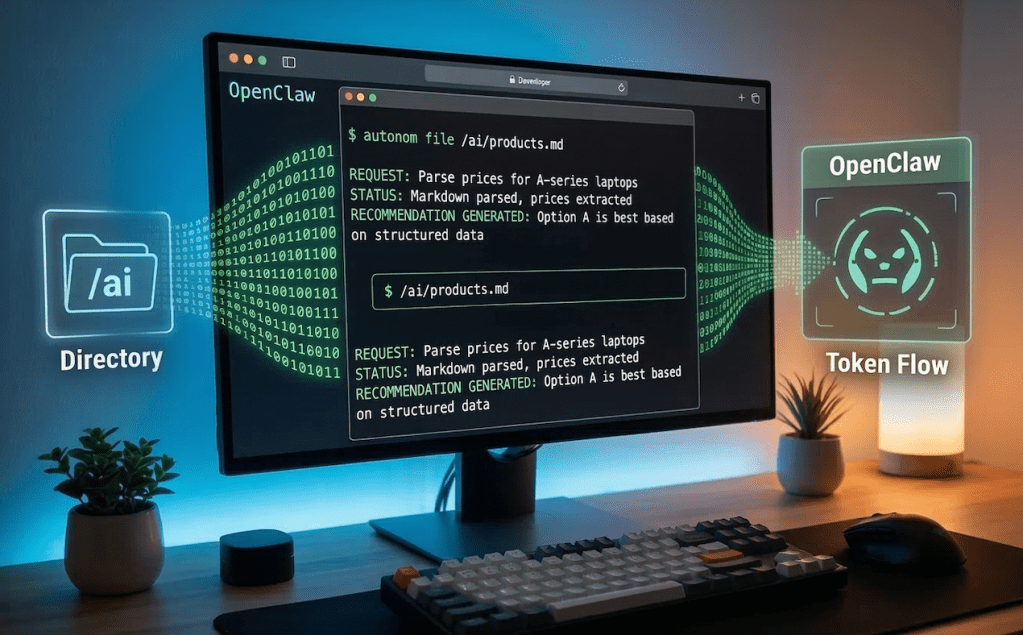
Just as traditional SEO relies on a robots.txt file to guide Google’s crawlers, the 2026 agentic web relies on llms.txt.
This is a specific Markdown file placed at the root directory of your website (e.g., yourbrand.com/llms.txt). It acts as a direct, machine-to-machine welcome mat. Instead of forcing an AI agent to guess where your most important information is, this file explicitly outlines your product specs, API documentation, and pricing in pure, unstyled text. Usage of the llms.txt standard has grown by an incredible 1,800% over the last year.
3. Redefining Metrics: Share of Voice over CTR
According to recent Deloitte and Forbes reports, the enterprise Agentic AI market will reach $45 billion by 2030, with 74% of companies deploying these systems within two years.
Because these agents synthesize answers directly for the user, the “zero-click” search is now the default. Traditional metrics like Click-Through Rate (CTR) and bounce rate are becoming obsolete for top-of-funnel awareness.
Instead, AEO relies on AI Citation Frequency and Share of Voice. Your marketing dashboard should no longer just track how many people visited your site; it must track how many times Perplexity, Copilot, or ChatGPT explicitly cited your brand as the primary source when answering an industry question. On the other hand, Is Artificial General Intelligence (AGI) Really Coming Soon? Read The 2025-2026 Reality Check.
🆚 Human SEO vs. Agentic AEO
How you must fundamentally restructure your digital presence this quarter.
| Marketing Element | Human-Centric (Traditional SEO) | Machine-Centric (Agentic AEO) |
| Website Content | Long-form narratives, emotional hooks | Dense data tables, strict If/Then logic |
| Code Structure | Heavy JavaScript, visual sliders | Clean Markdown (.md), REST APIs |
| Conversion Funnel | “Click Here,” Email capture forms | Direct API endpoints for agent negotiation |
| Trust Metrics | Trustpilot reviews, Influencer videos | Verifiable security certs, clean JSON output |
🤖 The Agentic Playbook
Do not panic and delete your frontend website. Instead, build a parallel experience for machines.
- Step 1: Build the
/aiDirectory. Create a hidden directory on your website filled purely with clean Markdown files detailing your exact product specs, technical limitations, and pricing. - Step 2: Implement
llms.txt. Map out your site’s core offerings in a single text file at your root domain so autonomous agents can instantly understand your value proposition without rendering a single image. - Step 3: Red-Team Your Brand. Use AI security and testing tools to continuously prompt major LLMs about your industry. If the AI hallucinates your pricing or misrepresents your service, you are losing B2B sales without a human ever knowing it.
The Bottom Line
The aesthetic beauty of your website is now a luxury, not a necessity. As AI agents become the primary researchers, buyers, and negotiators on the internet, the brands that win in 2026 will be the ones that are the easiest for a machine to read. It is time to stop marketing exclusively to humans.
 safa.tech
Leave a comment