The era of the human-dominated internet is officially ending. At the SXSW conference this week, Cloudflare CEO Matthew Prince announced a staggering projection: driven by the explosive growth of generative AI, autonomous bot traffic will permanently exceed human internet activity by 2027. This is not a temporary spike; it is a fundamental platform shift. For software engineers, it means re-architecting servers to handle unprecedented, continuous loads. For marketers, it means your website traffic metrics are likely inflated by machines, cementing the urgent need to pivot to Answer Engine Optimization (AEO).
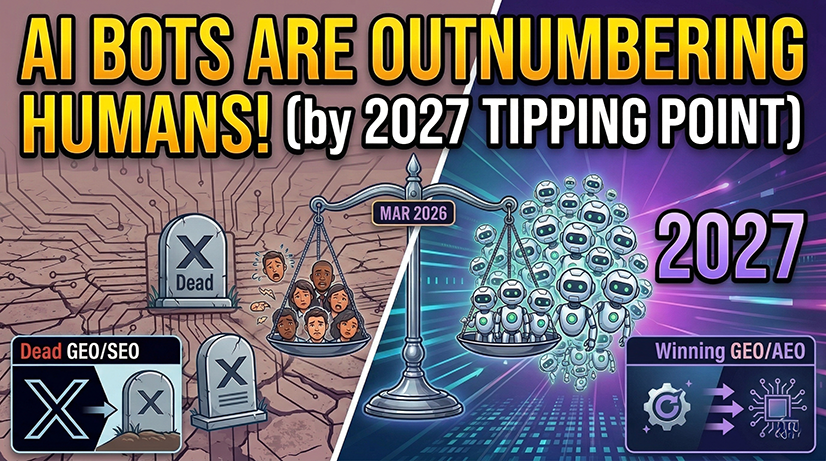
Why will bot traffic exceed human traffic by 2027?
The shift is driven by autonomous “Agentic AI.” As Cloudflare’s CEO explained, a human shopping for a camera might visit 5 websites. However, an AI agent performing that task on the user’s behalf will instantly scan 1,000 times that number, hitting up to 5,000 sites in seconds to compare data. Because these agents possess an “insatiable need for data,” the sheer volume of their automated HTTP requests will soon mathematically dwarf manual human browsing.
For decades, digital strategy relied on a simple assumption: if your server recorded a page view, a human being was on the other side of the screen.
Before the generative AI boom, bot traffic hovered at a stable 20%, consisting mostly of benign indexers like Googlebot and malicious scrapers run by bad actors. But this week, the company responsible for routing one-fifth of the entire global web sounded the alarm.
Here at safa.tech.blog, bridging the gap between raw computer science architecture and high-level digital marketing is the core focus. The math behind this transition is staggering. We are facing a “1,000x Bot Multiplier.” Here is the deep-dive research into how the Agentic Web is draining traditional server infrastructure, the brutal reality of the “Crawl-to-Refer” ratio, and what businesses must do to adapt. Read more The Rise of Personal Brands in 2025.
1. The Computer Science Reality: The 1,000x Multiplier
Speaking at SXSW in Austin, Cloudflare CEO Matthew Prince explicitly detailed how the architecture of web requests is fundamentally changing.
When humans use the internet, we are naturally bottlenecked by our reading speed and our ability to click tabs. When we delegate a task to an AI agent, those bottlenecks vanish.
“If a human were doing a task… you might go to five websites,” Prince noted during his SXSW interview. “Your agent or the bot that’s doing that will often go to 1,000 times the number of sites that an actual human would visit… And that’s real traffic, and that’s real load, which everyone is having to deal with.”
Prince compared this to the massive traffic surge during the 2020 COVID lockdowns. However, unlike COVID—where traffic spiked and eventually plateaued—the AI agent surge is a permanent platform shift that shows zero signs of stopping. To cope, Prince suggests the industry will need to engineer on-the-fly “sandboxes” disposable, isolated environments that can be spun up in milliseconds to service an agent’s code, then immediately torn down to save compute power. To more more, have a read: Why Consumers Follow Brand Rituals in 2025.
2. The Data: The Brutal “Crawl-to-Refer” Ratio
You do not have to wait until 2027 to see this shift; it is logged in your AWS billing right now. The bots hitting your site are no longer just indexing you for search; they are strip-mining your data for model weights.
Recent analysis of March 2026 AI crawler data reveals the harsh reality of the Crawl-to-Refer Ratio—how many pages an AI bot scrapes versus how many actual human clicks it sends back to your site:
- ClaudeBot (Anthropic): Crawls a staggering 23,951 pages for every single referral it sends back.
- GPTBot (OpenAI): Sits at a slightly better, but still heavy, 1,276:1 ratio.
- PerplexityBot: Offers a much more reasonable 111:1 ratio, actively citing sources and driving real GEO (Generative Engine Optimization) traffic.
- Meta-ExternalAgent: Now the second-most active bot on the entire web (trailing only Googlebot), Meta’s scraper consumes 36% of all AI crawl volume but offers zero referral mechanism. It takes your data to train Llama and Instagram AI features, giving publishers absolutely nothing in return.
3. The Marketing Threat: Traffic Inflation & Bandwidth Taxes
From a strategic business perspective, this “bot explosion” presents two massive, immediate threats to your bottom line.
1. The Vanity Metric Trap:
If your marketing dashboard shows a 40% increase in website traffic this quarter, but your sales pipeline is completely flat, you are likely suffering from AI Traffic Inflation. Marketers who still report on raw “Page Views” and “Time on Site” are blindly optimizing their funnels for robots that will never enter a credit card number.
2. The Compute Tax:
Hosting isn’t free. Every time a fleet of agents from Anthropic or Meta scrape your high-resolution images, heavy JavaScript files, and bloated DOM trees, you pay for the bandwidth. If 60% of your web traffic is automated, you are actively subsidizing Silicon Valley’s AI training costs with your own monthly infrastructure bills.
The 2026 Traffic Shift Table
How the fundamental nature of an HTTP request is changing.
| Metric | The Human Web (Pre-2024) | The Agentic Web (2026-2027) |
| Dominant Traffic Source | Human browsers (80%) | Autonomous AI Agents / Bots (>50%) |
| Site Visits Per Task | 3 to 5 sites | 1,000 to 5,000 sites |
| Aggressive Crawlers | Googlebot (Search Indexing) | Meta-ExternalAgent & ClaudeBot (Training) |
| Infrastructure Need | Persistent GUI Servers | Ephemeral “Sandboxes” & APIs |
| Marketing Goal | Click-Through Rate (CTR) | Generative Engine Citation |
Guide on How to Protect Your Server & Your Brand
The solution to the 1,000x bot multiplier isn’t to indiscriminately block all AI agents via your .htaccess file. If you block GPTBot, your brand is invisible when a CEO asks ChatGPT for B2B recommendations. The solution is to control how they access your data.
- IF you are a Developer/Sysadmin…
- 👉 BLOCK THE VAMPIRES, ALLOW THE SEARCHERS. Update your
robots.txtto aggressively blockMeta-ExternalAgent(which offers zero ROI). However, you must strategically allowGPTBotandPerplexityBotto ensure your brand survives in the new GEO landscape.
- 👉 BLOCK THE VAMPIRES, ALLOW THE SEARCHERS. Update your
- IF you are a Digital Marketer/Founder…
- 👉 FORCE THE AGENTS TO YOUR
/aiDIRECTORY. As discussed in our previous guide, you must deploy anllms.txtfile (currently adopted by only 10% of domains) and a clean Markdown directory. Redirect AI bots away from your expensive, image-heavy GUI, and point them exclusively to your lightweight, text-only Markdown files.
- 👉 FORCE THE AGENTS TO YOUR
- The Result: The AI agent gets your product specs instantly, your brand gets cited in the AI’s final answer, and your server bandwidth costs drop by 80%.
Learn more about How to Write an llms.txt File: Syntax, Rules, and Boilerplate Code.
The Bottom Line
Matthew Prince’s warning is not science fiction; it is the current reality logged in server racks around the globe. The transition from desktop to mobile changed how websites looked. The transition from human to bot is changing why websites exist.
 safa.tech
Leave a comment