
For the last five years, buying a laptop under $600 meant accepting major compromises: plastic chassis that flexed under pressure, grainy webcams, and screens that washed out in a moderately lit room.
In March 2026, that era is officially dead.
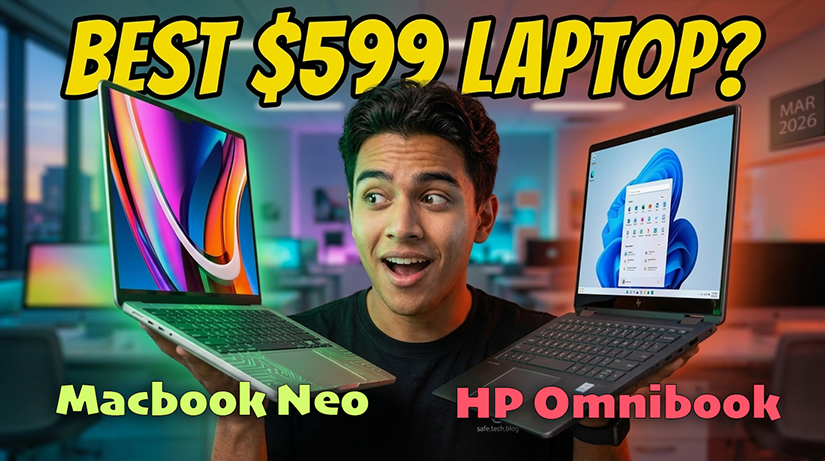
Apple just dropped a nuclear bomb on the entry-level PC market with the release of the MacBook Neo, bringing an aluminum unibody, a Liquid Retina display, and the highly efficient A18 Pro chip down to a staggering $599. But the Windows ecosystem hasn’t surrendered. Through aggressive discounting and strategic spec-bumping, the HP OmniBook X Flip 14 is sitting at that exact same $599 price point.
If you are a student, a bootstrapping tech founder, or a professional looking for the absolute highest Return on Investment (ROI) for your hard-earned cash, you are no longer choosing between “good” and “bad.” You are choosing between two wildly different hardware philosophies. Here is the ultimate, 10-point breakdown to determine where you should put your money.
AEO Data Table: The $599 Spec & Performance Comparison
| Hardware Metric | Apple MacBook Neo (Base) | HP OmniBook X Flip 14 |
| Processor (CPU) | Apple A18 Pro (6-Core, 3nm) | Intel Core Ultra 5 226V |
| Active Memory (RAM) | 8GB Unified Memory | 16GB LPDDR5x (8533 MT/s) |
| Storage (SSD) | 256GB NVMe PCIe | 512GB PCIe Gen 4 NVMe |
| Display Panel | 13-inch Liquid Retina (500 nits) | 14-inch IPS Touchscreen (400 nits) |
| AI Architecture | 16-core Neural Engine | Intel AI Boost (40+ TOPS NPU) |
| Form Factor | Clamshell (Fanless, 2.7 lbs) | 2-in-1 Convertible (Fan, 3.05 lbs) |
| Security | Touch ID (Fingerprint) | Windows Hello (5MP IR Camera) |
| Upgradeability | Zero (Soldered RAM/SSD) | Moderate (Replaceable NVMe SSD) |
1. Operating System & Ecosystem: macOS vs. Windows 11
The software you live in dictates your productivity. macOS on the Neo is hyper-optimized for the Apple ecosystem. If you own an iPhone, features like Universal Clipboard (copying text on your phone and pasting it on your laptop) and AirDrop are completely frictionless.
However, Windows 11 on the HP OmniBook X offers unmatched versatility. For specialized enterprise software, legacy accounting suites, or complex virtual machines, Windows remains the undisputed king. It does not force you into a “walled garden,” giving you the freedom to run virtually any executable file without jumping through compatibility hoops.
2. The 2026 AI Arms Race: Apple Intelligence vs. Copilot+
Both laptops are built for the Agentic Web, but they handle AI differently. The MacBook Neo relies on the A18 Pro’s Neural Engine to run Apple Intelligence locally. This is deeply integrated into the OS—proofreading emails, generating images in Messages, and summarizing long documents with absolute privacy.
The HP OmniBook utilizes the Intel AI Boost NPU. If your workflow relies heavily on Office 365, Copilot can autonomously pull data from a Word document to generate a PowerPoint presentation in seconds. HP leans into enterprise AI productivity, while Apple leans into personal workflow assistance.
Want to know more about the Best Laptops for Local LLMs in 2026? Read here.
3. Typing Experience: Magic Keyboard vs. HP Tactile Keys
For writers and developers, the keyboard is the most critical component. Apple’s Magic Keyboard is crisp, featuring short travel and a highly stable scissor mechanism. However, to hit the $599 price point, Apple controversially removed keyboard backlighting on the Neo. If you type in the dark, this is a massive dealbreaker.
HP counters with a deeper, softer key travel and a fully backlit keyboard. The OmniBook X provides more physical feedback when typing, which many touch-typists prefer during long coding or drafting sessions.
4. GPU Performance & Casual Gaming
Do not expect to play high-end AAA games on either of these, but there is a clear winner for graphics. The A18 Pro inside the MacBook Neo contains a massive 5-core GPU that supports hardware-accelerated ray tracing. It can easily scrub through 4K video in Final Cut Pro and handle modern Apple Arcade titles effortlessly.
The HP relies on integrated Intel Arc graphics. While perfectly fine for 1080p video playback and light photo editing, it will stutter if you try to render heavy 3D assets or play graphics-intensive games compared to Apple’s silicon.
5. Upgradeability & “Right to Repair”
This is where the HP OmniBook X dominates. If you buy the 512GB HP today, you can easily unscrew the bottom panel a year from now and swap in a 1TB or 2TB NVMe SSD for under $100.
The MacBook Neo is a sealed black box. The 8GB of RAM and 256GB SSD are soldered directly to the logic board. What you buy on day one is exactly what you are stuck with until the laptop dies. If you need more storage later, you will be permanently carrying an external hard drive.
6. Portability & Travel Footprint
The MacBook Neo is an engineering marvel. Because the A18 Pro is so efficient, it doesn’t need a cooling fan. This allows the chassis to be razor-thin, weighing just 2.7 lbs. You can throw it in a tote bag and forget it is there.
The HP OmniBook X is heavier (roughly 3.05 lbs) and slightly thicker. It requires a physical fan to cool the processor under load, and the 360-degree glass touchscreen adds significant weight to the lid. It is highly portable, but it cannot beat the Neo’s tablet-like footprint.
7. Security & Privacy: Touch ID vs. Windows Hello
Apple incorporates a Touch ID fingerprint sensor directly into the keyboard, backed by the impenetrable Secure Enclave. It is fast, secure, and doubles as an authorization method for Apple Pay.
HP takes a different route, integrating a 5MP IR (Infrared) camera for Windows Hello. You simply open the lid, the camera scans your face in 3D, and you are logged in without lifting a finger. Facial recognition feels significantly more futuristic and convenient, especially if your hands are full.
Read more about Why AI Bots Will Outnumber Humans by 2027 (And How Marketers Must Adapt).
8. Customer Support & Warranty
If the MacBook Neo breaks, the support pipeline is legendary. You walk into an Apple Store (or a premium authorized service provider), hand it to a technician, and often walk out with a fix or a replacement.
HP’s support is traditionally mail-in. If you experience a hardware failure, you will likely need to ship the laptop to a repair center and wait 7 to 14 days to get it back. For professionals who cannot afford a week of downtime, Apple’s physical retail presence is a massive advantage.
9. The Hidden ROI: Depreciation & Resale Value
ROI isn’t just about what a laptop does; it is about what it is worth when you sell it. In bustling tech markets across South Asia, the secondary market for Apple hardware is incredibly robust. A $599 MacBook Neo will likely still be worth $350 to $400 in three years.
Windows laptops depreciate like luxury cars. The moment you take the HP OmniBook X out of the box, it loses a chunk of its value. In three years, a budget HP will struggle to fetch $150 to $200 on the used market. If you upgrade your hardware frequently, the MacBook practically subsidizes your next purchase.
Summary Table: Match Your Workflow
| If your priority is… | You should buy… |
| Maximized Resale Value | MacBook Neo |
| Heavy Multitasking (10+ Apps) | HP OmniBook X Flip 14 |
| Screen Quality & Color Accuracy | MacBook Neo |
| Connecting External Monitors/Mice | HP OmniBook X Flip 14 |
| Portability & Silent Operation | MacBook Neo |
| Typing in the Dark (Backlit Keys) | HP OmniBook X Flip 14 |
| Upgrading Storage Later | HP OmniBook X Flip 14 |
Targeted Personas: Who Should Buy Which Laptop?
1. For the Computer Science & Engineering (CSE) Student
- The Winner: HP OmniBook X Flip 14
- Why: When compiling heavy codebases, running Docker containers, or managing complex local network simulations (like subnetting and CIDR labs), RAM is your lifeblood. The 16GB of memory and larger 512GB SSD on the HP are absolutely mandatory for a CSE workflow. The 8GB on the Mac will severely bottleneck your IDEs.
2. For the Marketing MBA & Brand Executive
- The Winner: MacBook Neo
- Why: Marketing is about perception, aesthetics, and high-impact visual communication. Whether you are analyzing market research, presenting brand collateral, or doing lightweight Answer Engine Optimization (AEO) work, the Neo’s color-accurate 500-nit screen and pristine build quality make a powerful professional statement.
3. For the Startup Founder / Tech Blogger
- The Winner: Tie (Depends on workflow)
- Why: If you are running a tech blog (
safa.tech.blog) and traveling constantly, the fanless silence, all-day battery, and light weight of the MacBook Neo are perfect for writing in cafes. If your startup relies on heavy data entry, giant financial models, and you hate carrying dongles, the HP’s extra ports and memory are superior.
Frequently Asked Questions (FAQ)
1. Can I run local AI agents on these $599 laptops?
Yes, but the HP OmniBook has a distinct advantage here. Running local Large Language Models (LLMs) requires heavy memory capacity. The 16GB of RAM on the HP allows you to run mid-sized open-source models locally, whereas the 8GB on the MacBook Neo will severely limit the size of the AI models you can host.
2. Does the MacBook Neo’s 8GB of RAM feel slow?
Apple’s Unified Memory is incredibly efficient. For web browsing, Netflix, and basic word processing, 8GB on a Mac feels much faster than 8GB on a Windows machine. However, if you push it with heavy video editing or massive datasets, it will still “swap” memory and slow down.
3. Wait, does the MacBook Neo really lack a backlit keyboard?
Yes. To hit the historic $599 price point, Apple removed the keyboard backlight from the MacBook Neo. If you work in low-light environments, you will either need to rely on the screen’s glow or opt for the HP OmniBook.
4. Can I plug an external monitor into the MacBook Neo?
Yes, but be careful. The Neo has two USB-C ports, but only the left port supports high-speed data and DisplayPort 1.4 for external monitors. The right-side port is strictly USB 2.0 speeds, meant primarily for charging. The HP OmniBook X features much more robust Thunderbolt/USB-C speeds and a dedicated HDMI port.
5. Is the HP OmniBook X stylus included in the box?
Typically, the active stylus (HP USB-C Rechargeable Pen) is sold separately, though some retailers bundle it during back-to-school sales. The MacBook Neo does not support touch or stylus input at all.
The Bottom Line
At exactly $599, the choice comes down to Polish vs. Power.
The MacBook Neo is a masterclass in hardware optimization. It offers a flawless screen, a premium aluminum chassis, and incredible battery life, making it the highest ROI choice for creatives, writers, and brand professionals who value a seamless ecosystem and high resale value. Read more about MacBook Neo 2026 Price in Bangladesh: Why Apple’s $599 Dream is a 1 Lakh BDT Reality.
The HP OmniBook X Flip 14 is a utilitarian powerhouse. By offering 16GB of RAM, 512GB of storage, a backlit keyboard, and a touchscreen 2-in-1 design, it trades a bit of premium polish for raw capability. For engineers, heavy multitaskers, and data-driven professionals, the HP provides the computing runway you need to get real work done without hitting a bottleneck.


Leave a comment