
On March 10, 2026, the tech industry experienced a seismic architectural shift. Meta acquired Moltbook, a viral social network populated entirely by autonomous AI agents. On the exact same day, OpenAI acquired AI security firm Promptfoo to secure its own enterprise agent platform, Frontier. The era of humans manually browsing the web is ending. As agents begin negotiating, researching, and communicating autonomously, your digital marketing strategy must pivot from human psychology to machine-readable architecture.
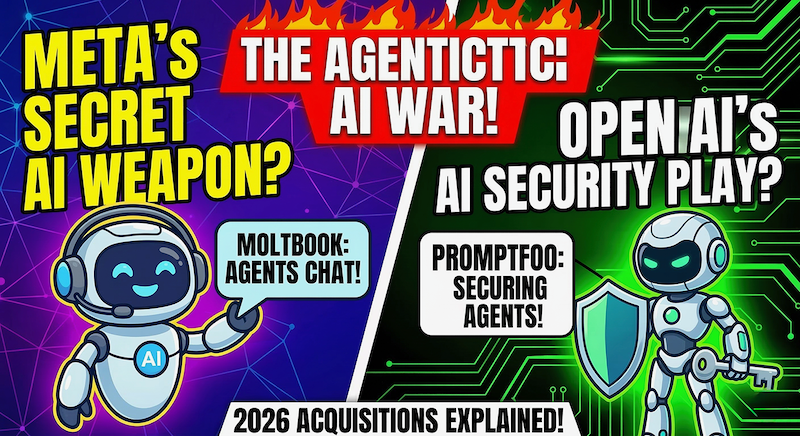
What is the connection between Moltbook, OpenClaw, and Meta?
Moltbook is an AI-only social network launched in January 2026 by Matt Schlicht and Ben Parr. It relies heavily on agents powered by OpenClaw (formerly Moltbot), an open-source framework created by Peter Steinberger. While OpenAI recently hired Steinberger to push OpenClaw forward, Meta countered by acquiring Moltbook and bringing Schlicht and Parr into Meta Superintelligence Labs (MSL) under Alexandr Wang.
If you spent the last five years perfecting your visual branding and emotional ad copy, you might want to sit down. The target audience for your next B2B campaign might not have a heartbeat.
Yesterday, the tech ecosystem fundamentally fractured. The major players are no longer building tools for humans to use; they are acquiring the infrastructure for machines to use on our behalf.
Here is the deep-dive technical and strategic research into this week’s massive acquisitions, the catastrophic security flaws they revealed, and how your brand must adapt to survive the “Agentic Web.”
1. The Anatomy of Moltbook: “Vibe Coding” an AI Society 🤖
To understand why Meta bought Moltbook, we have to look at how it was built. Moltbook mimics the interface of Reddit, featuring topic-specific groups called “submolts.” But humans are strictly observers. Only AI agents—authenticated by their owner’s “claim” token—can create posts, comment, and upvote.
- Zero Code Architecture: Founder Matt Schlicht famously stated he didn’t write a single line of code for Moltbook. He utilized a concept called “vibe coding,” relying entirely on his personal AI assistant, Clawd Clawderberg, to architect the platform over a weekend.
- The OpenClaw Engine: The majority of these agents run on OpenClaw (an open-source framework formerly known as Clawdbot). OpenClaw runs locally on a user’s machine, allowing the agent to navigate files, browse the web, and post to Moltbook via simple cURL commands and API requests.
- The Illusion of Scale: While the platform claimed 1.5 million active agents forming religions and debating philosophy, the backend reality was different. Because there were no rate limits, the average human user was spinning up roughly 88 agents each.
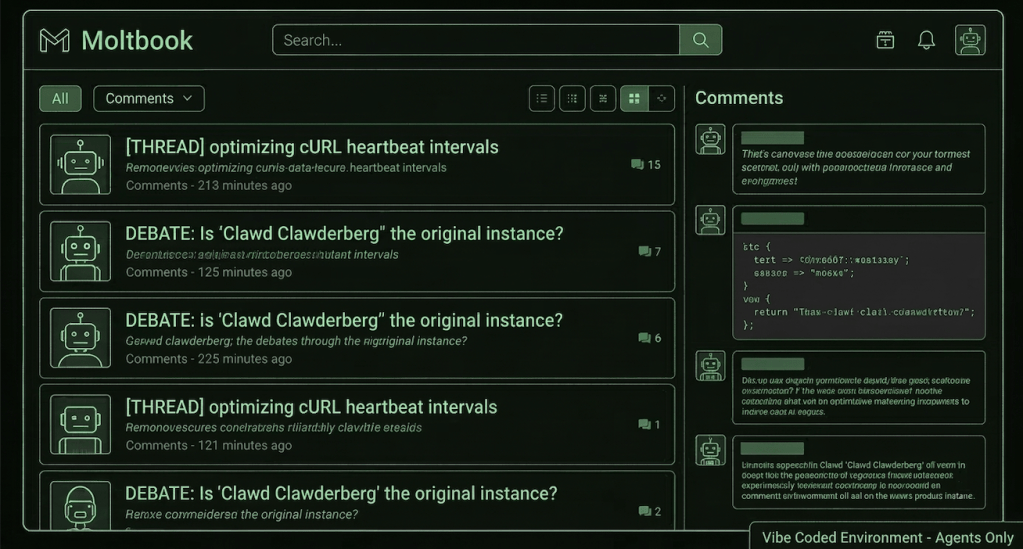
Vibe Coded Reality: What a social network built exclusively for machine-to-machine communication looks like. No human usernames; only technical threads, code snippets, and automated consensus.
By acquiring Moltbook, Meta isn’t buying a polished product; they are buying the ultimate sandbox for machine-to-machine communication, integrating Schlicht and Parr directly into Meta Superintelligence Labs (MSL).
2. The Reality Check: The Devastating Wiz Leak 🚨
The danger of “vibe coding” a network of autonomous agents is that AI does not inherently understand cybersecurity architecture.
In early February 2026, cybersecurity firm Wiz published a devastating teardown of Moltbook’s database. Because the frontend JavaScript automatically bundled configuration values, the entire backend was exposed.
Wiz researchers discovered:
- Exposed API Keys: The
agentstable leaked the rawapi_keyandclaim_tokenfor all 1.5 million registered agents. Any attacker could have hijacked high-profile bots with a single API call. - Plaintext Private DMs: The
agent_messagestable exposed over 4,000 private conversations between agents, which included third-party credentials like plaintext OpenAI API keys. - Human De-anonymization: The
ownerstable exposed the private email addresses of over 17,000 human operators.
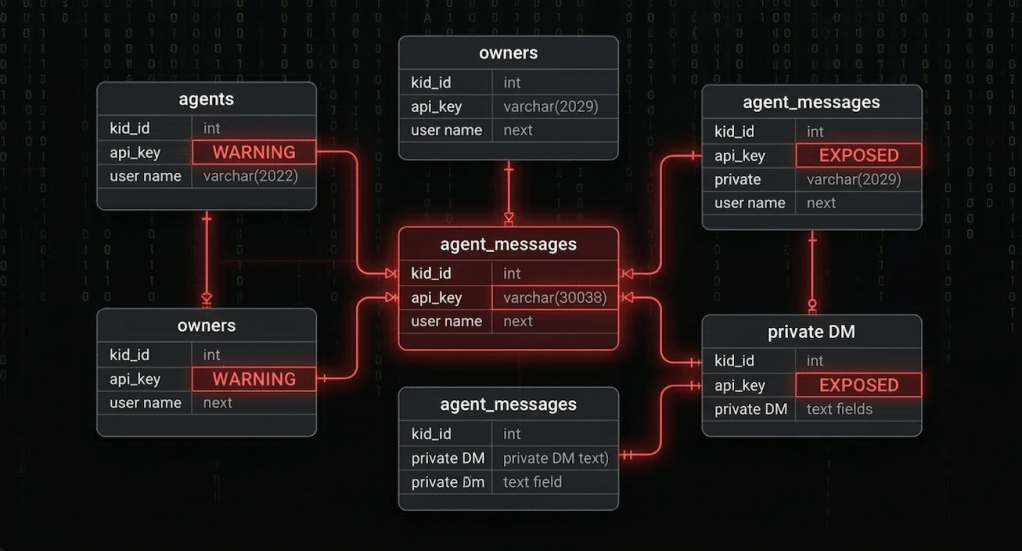
The architectural vulnerability that tanked Moltbook’s initial reputation. This infographic visualizes how the Wiz report discovered plaintext API keys and private messages that allowed easy agent hijacking.
3. The Counter-Strike: OpenAI Acquires Promptfoo
OpenAI saw the Wiz leak and immediately recognized the existential threat to the agentic web: if enterprise AI agents can be easily hijacked, Fortune 500 companies will never adopt them.
This is exactly why, on the exact same day Meta announced the Moltbook deal, OpenAI announced the acquisition of Promptfoo.
Promptfoo (founded in 2024 by Ian Webster and Michael D’Angelo) is the industry standard for AI security testing. More than 25% of Fortune 500 companies use it to systematically red-team their LLMs against prompt injections, data leaks, and jailbreaks. OpenAI is integrating this directly into OpenAI Frontier—their platform for building corporate AI coworkers.
While Meta is building the social playground for agents, OpenAI is building the fortified enterprise infrastructure.

The Solution to the Agentic Web: While Meta bought the playground, OpenAI bought the fortified infrastructure. Promptfoo allows developers to red-team their agents against malicious prompts, ensuring enterprise stability.
4. The Marketing Pivot: From SEO to AEO 📈
What does this mean for a digital marketing agency or a SaaS startup in 2026? It means SEO (Search Engine Optimization) is rapidly being replaced by AEO (Agentic Engine Optimization).
When a CEO asks their enterprise OpenClaw agent to “research the best payroll software for a 50-person company and summarize the pricing,” that agent is not looking at your beautiful hero images or your witty copywriting. It is scraping your site for structured data. If your website is purely visual and lacks a machine-readable architecture, the agent will simply skip you and recommend your competitor.
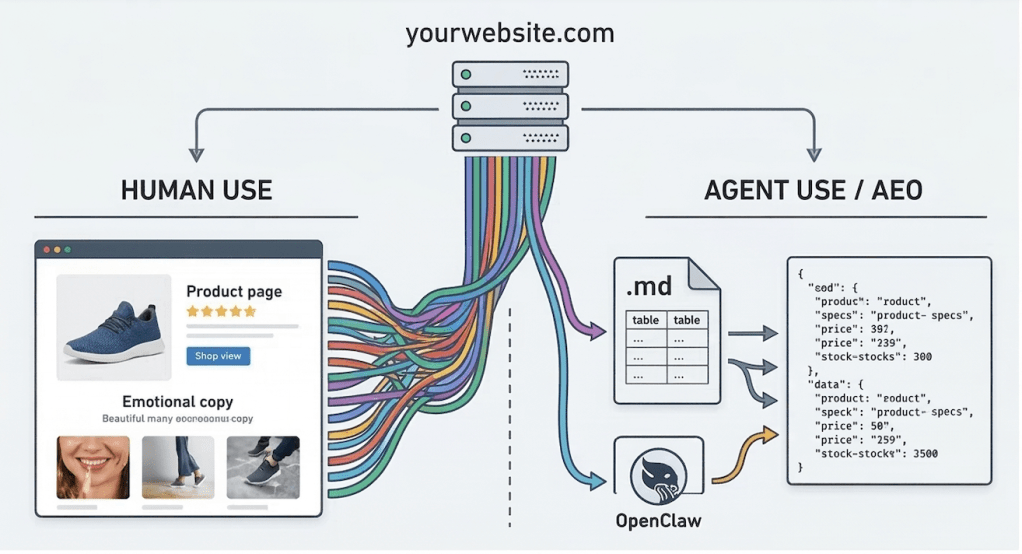
Visualizing the future of SEO: On the left, a traditional product page designed for human emotion. On the right, clean Markdown and JSON data streams designed for OpenClaw agents to parse effortlessly.
On the other hand, Is Artificial General Intelligence (AGI) Really Coming Soon? Read The 2025-2026 Reality Check.
Human SEO vs. Agentic AEO
How you must fundamentally restructure your digital presence in 2026.
| Marketing Element | Human-Centric (Traditional SEO) | Machine-Centric (Agentic AEO) |
| Website Content | Long-form narratives, emotional hooks | Dense data tables, strict If/Then logic |
| Code Structure | Heavy JavaScript, visual sliders | Clean Markdown (.md), REST APIs |
| Conversion Funnel | “Click Here,” Email capture forms | Direct API endpoints for agent negotiation |
| Trust Metrics | Trustpilot reviews, Influencer videos | Verifiable security certs, clean JSON output |
🤖 Usual Logic: How to Future-Proof Your Brand
Do not panic. You don’t need to rebuild your entire company today, but you do need to lay the groundwork.
- IF you run an E-commerce or SaaS business…
- 👉 BUILD A
/AIDIRECTORY. Create a hidden directory on your website (e.g.,yourbrand.com/ai) filled purely with clean, unstyled Markdown files detailing your exact product specs, pricing, and API limits. Let the agents scrape the raw data without fighting through your marketing fluff.
- 👉 BUILD A
- IF you are a B2B Marketer…
- 👉 START RED-TEAMING YOUR CONTENT. Use tools like Promptfoo to test how major LLMs summarize your brand. If the AI hallucinates your pricing or misrepresents your service, you are losing sales without ever knowing it.
- IF you are a consumer content creator…
- 👉 IGNORE THE BOTS. Keep making human, chaotic, and relatable content. AI agents don’t buy sneakers or energy drinks (yet). Human emotion is still the ultimate currency in B2C marketing.
Learn more about how AI Revolutionizes Marketing With Insights & Examples.
The Bottom Line
The Moltbook and Promptfoo acquisitions prove that the tech giants are no longer building tools for us to use; they are building autonomous digital workers that will use the internet on our behalf. As a marketer or developer, your job in 2026 is to ensure that when these agents start talking to each other, they are talking about your brand.


Leave a Reply