
TL;DR: Traditional VPNs are a bloated, expensive disaster. While the hardware-level IPv8 routing draft remains an internet myth, the actual, functioning IPv8—a cryptographic Python library by TU Delft—is actively destroying the need for perimeter firewalls by baking Zero Trust directly into peer-to-peer meshes.
Let’s be completely honest. Firewall is now a joke.
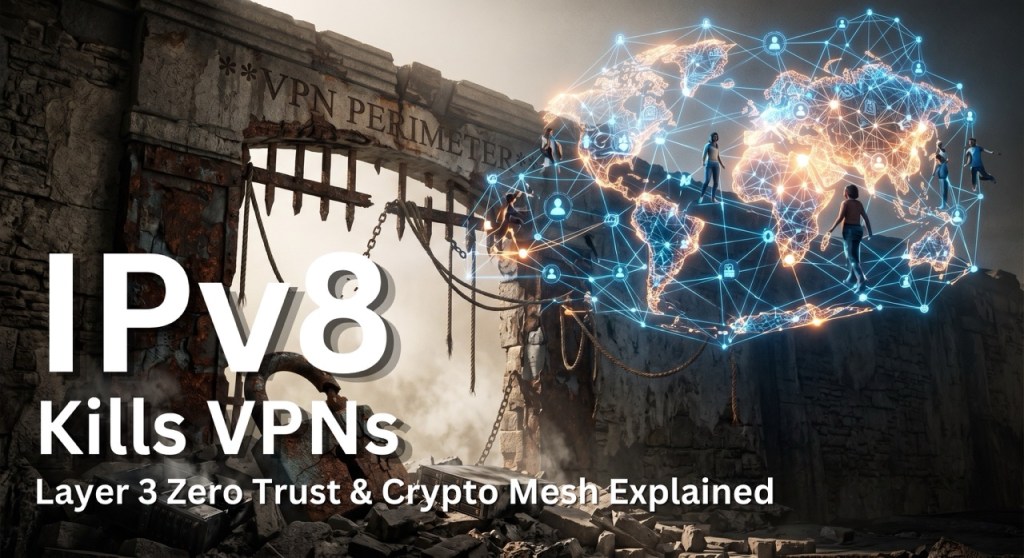
We constantly slap flimsy application-layer bandages over gaping network-layer wounds. We try to hide the fact that legacy internet protocols blindly trust anything with a heartbeat, hoping nobody notices the structural rot beneath the floorboards. It happens every single day. Your exhausted systems administrator stays up until three in the morning. They configure a massively expensive, supposedly impenetrable enterprise VPN tunnel so the remote sales team can access an internal SQL database without breaking a sweat. It works perfectly. The tickets are closed. Then a C-level executive connects their heavily compromised laptop from a sketchy airport Wi-Fi network, effortlessly bypasses that multi-million dollar digital moat you just built, and burns your highly sensitive internal subnets straight to the ground in minutes.
You sit there at your desk, drinking cold, stale coffee. Wondering why your company just renewed a six-figure contract for this absolute garbage.
Pull the plug.
The VPN Bloodbath
The traditional firewall perimeter is already dead. We just refuse to bury the corpse. Cybersecurity vendors keep successfully selling us shiny, heavily marketed new boxes to temporarily patch the glaring vulnerabilities in the older boxes they sold us just twelve months ago.
Look at the absolute bloodbath surrounding the Ivanti Connect Secure zero-day exploits documented by CISA. State-sponsored threat actors didn’t bother trying to brute-force complex internal servers. They chained a few bypass vulnerabilities together, completely sidestepped multi-factor authentication protocols, and directly hijacked the exact edge appliances that were specifically purchased and deployed to protect the network. When your primary defense mechanism becomes your single largest attack vector, you have fundamentally lost the war. It’s embarrassing.
If you want a more historical, gut-wrenching example, just look back at the Colonial Pipeline ransomware attack. The hackers didn’t use some incredibly sophisticated, movie-style hacking montage to shut down the fuel supply for the entire East Coast of the United States. They literally just walked through the front door using a single compromised password on a legacy VPN account that did not have multi-factor authentication enabled.
Ancient Architecture
We are relying on ancient architecture till now. Thus every enterprise is currently struggling with this exact perimeter problem, bleeding cash to protect vulnerable IPv4 addresses that inherently want to connect to everything. We need a fundamental shift.
The Vaporware Router: IETF Draft
For a while, a massive rumor tore through engineering message boards regarding a hardware-level proposal. The April 2026 IETF draft for IPv8. It sounded like magic. Want to know more about What is IPv8? Read here!
Instead of hoping perimeter gateways keep the bad traffic out, this proposal demands we kill unauthorized traffic at the physical source. It rips Zero Trust Network Access out of the hands of expensive SaaS vendors and shoves it directly into the foundational network architecture. The draft mandates that every single manageable packet must be authorized via local OAuth2 JSON Web Tokens (JWT).
Think about the sheer audacity of that concept for a second.
Packets physically cannot leave edge routers without cryptographic routing proof and a verified DNS lookup. Malware command-and-control servers that rely on hardcoded IPs break instantly. The packet drops before it ever hits the wire. The OSI model gets completely rewritten here. Zero-trust logic lives inside the IP header itself. Your heavy, bottlenecked VPN concentrator basically becomes an expensive doorstop because the router acts as the ultimate bouncer.
The ASIC Meltdown
Hardware vendors are quietly panicking behind closed doors.
Trying to parse a JSON Web Token on every single packet at a 400 Gbps line rate will literally melt modern ASIC chips into slag. You can write all the beautiful network drafts you want. Silicon physics is brutally unforgiving. Right now, this draft is an incredible thought experiment that highlights exactly how frustrated the industry is with our current options, but you won’t be racking one of these routers anytime soon.
A Tale of Two IPv8s
To understand where we are actually heading, you need to see the difference between the hardware pipe dream and the software reality.
| Core Feature | IETF Draft (Hardware) | TU Delft py-ipv8 (Software) |
| Core Mechanism | Layer 3 JWT Authorization | Cryptographic Public Key Mesh |
| Current Status | Theoretical Internet-Draft | Live, Active Open-Source Deployment |
| Firewall Interaction | Becomes the Ultimate Firewall | Bypasses Firewalls via UDP Hole-Punching |
| Identity Proof | OAuth2 Tokens in IP Headers | TrustChain Distributed Ledger |
| Corporate Appeal | CISOs love the absolute control. | Security teams despise the unauthorized P2P traffic. |
The Real IPv8: TU Delft’s Python Mesh
If you pivot away from the physical routers and look at the software overlays being built right now, the funeral for the VPN is heavily booked.
Engineers and researchers at the Delft University of Technology bypassed the hardware fight entirely. They built the real IPv8. It is an open-source, highly aggressive Python library known as py-ipv8, and it frankly does not give a damn about your strict corporate security policies.
This is not a theoretical whitepaper gathering dust. This library is the foundational networking layer powering Tribler, a heavily scaled, decentralized application running in the wild today.
It completely eviscerates the traditional concept of the virtual private network.
Bypassing the Firewall
Instead of routing traffic to a vulnerable, centralized IP address managed by a massive tech corporation, the IPv8 software library forces peers to connect directly using cryptographic public keys. The physical IP address becomes completely irrelevant. It utilizes brutal, unapologetic UDP hole-punching techniques to blast highly encrypted tunnels straight through restrictive Carrier-Grade NATs and aggressive corporate firewalls.
Peers authenticate the math. Not the location.
There are zero central servers waiting to be breached by a zero-day exploit. There are no sluggish VPN concentrators artificially throttling your outbound throughput because a certificate randomly expired on a Tuesday.
Corporate security teams absolutely despise this technology. They hate it with a burning passion. When you have unauthorized, peer-to-peer traffic piercing your expensive perimeter defenses, it blinds your deep packet inspection tools and renders your expensive intrusion detection systems completely useless. Security operations centers will fight this tooth and nail, attempting to deploy draconian endpoint management software just to kill the processes.
Developers simply do not care.
They are actively building decentralized, serverless applications that view corporate firewalls as annoying censorship protocols that must be actively routed around. The secure cryptographic stream protects the data payload regardless of the underlying network environment. You could be sitting in a coffee shop using a router infected with malware. The mathematical handshake occurring inside the IPv8 overlay ensures an untappable, mathematically verified connection between two specific identities.
We love throwing that term around in vendor meetings. We rarely actually practice it. True Zero Trust means assuming the network is always hostile. If the network is always hostile, why are we spending millions trying to secure the network itself? The IPv8 paradigm shifts the security burden entirely to the endpoints and the data.
Think about the legacy mechanics of a standard SSL VPN. Your machine establishes a secure tunnel to a gateway. Once you pass the gateway, you are typically granted wide-ranging access to a specific subnet. You are inside the castle walls. If an attacker compromises your machine, they inherit that trust immediately.
Cryptographic routing destroys that model entirely.
In a public key mesh network, passing one authentication check does not grant you the keys to the kingdom. Every single connection to every single peer is treated as a highly suspicious, isolated event that requires mathematical proof of identity. If a node is compromised, the blast radius is contained exactly to that single node. The infection cannot spread laterally because the neighboring nodes will mathematically reject unverified requests.
This transition is going to be incredibly painful for traditional IT departments.
We have spent three decades training network engineers to think in terms of subnets, access control lists, and perimeter gateways. We measure our security posture by how thick the walls are. Now, we are asking those same engineers to completely abandon the wall and focus entirely on the cryptographic identity of the people standing inside the courtyard. It requires a massive psychological shift.
Furthermore, the implementation of these decentralized libraries comes with massive regulatory headaches. When traffic routes through a decentralized mesh rather than a central corporate server, logging and compliance tracking become an absolute nightmare for auditors. How do you prove to a rigid compliance officer that a highly sensitive financial data transfer met specific geographic restrictions—like GDPR—when the packet data bounced through a randomized series of cryptographic peers in three different countries?
You simply can’t do it with today’s tools.
The auditing software industry is lightyears behind this cryptographic curve. But the alternative is sticking with the devil we know. The devil that currently allows lazy ransomware gangs to systematically dismantle critical national infrastructure because a single junior employee reused a personal password on a globally exposed VPN portal.
We are currently watching a massive, ugly turf war unfold between legacy hardware appliance vendors and bleeding-edge software overlay developers. The hardware vendors want you to keep paying recurring annual licenses for their firewalls, their threat feeds, and their endpoint agents. The software developers want to make those firewalls entirely irrelevant, stripping power from the network admins and giving it directly to the application layer.
Both sides share one glaring, highly uncomfortable truth that nobody wants to say out loud in a corporate board meeting. The old way of establishing secure remote access is failing spectacularly on a global scale. Stop clinging to your outdated perimeter firewalls and legacy VPN tunnels like a childhood safety blanket. The shift toward cryptographic routing and true decentralized identity isn’t just a buzzword thrown into a startup pitch deck to pump a valuation.
It is absolute survival.


Leave a reply to What is IPv8? The 2026 IETF Draft & P2P Network Explained – safa.tech.blog Cancel reply